
What 25,000 Square Feet of Clubhouse Actually Contains
Twenty-five thousand square feet at Sanctuary buys eight distinct rooms. Some carry an ordinary Tuesday; the rest photograph well and still appear on every owner's maintenance bill.
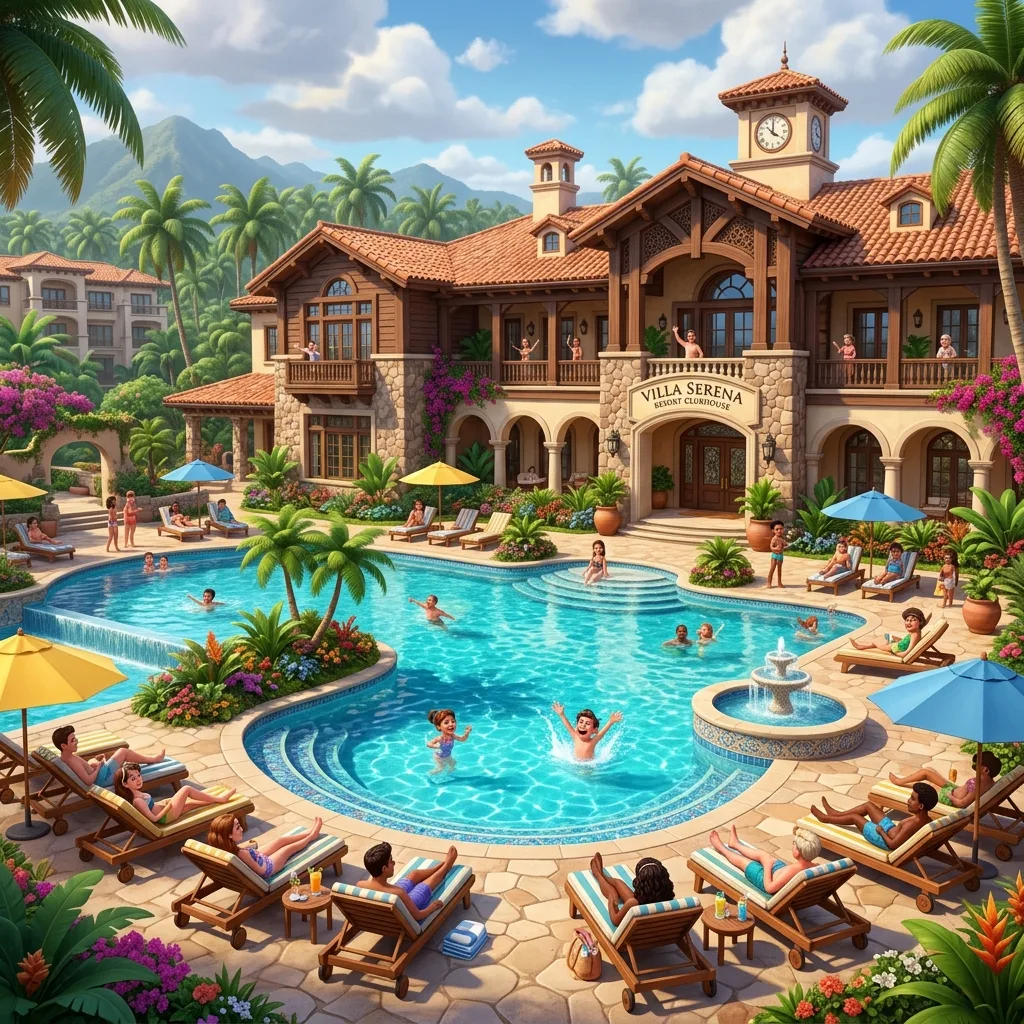
Twenty-five thousand square feet at Sanctuary is spent as follows: a banquet hall, a restaurant and café, a swimming pool complex, two indoor badminton courts, a gym, an indoor games lounge, a business centre with co-working desks, and three guest suites.
That list is the argument. Each room answers a specific recurring problem in an Indian household's week, and the rooms that answer daily problems are rarely the ones that appear in the photographs.
What each of those rooms is for
The banquet hall is for the events a family cannot hold at home and would otherwise hire a function hall across the city to stage: weddings, sangeets, naming ceremonies, an association's annual day. Its real job is to keep those occasions within walking distance of the people attending them.
The restaurant and café is the room that converts intention into contact. "We must catch up" becomes a fifteen-minute reality when the venue is a four-minute walk. It is also, quietly, where a community's information travels.
The pool complex and the gym are health infrastructure with an enforcement mechanism attached, and the mechanism is proximity. The two badminton courts are competitive infrastructure, and indoors is the operative word — a covered court works through a May afternoon and through the monsoon, which an open one does not. The indoor games lounge serves the carrom, chess and cards constituency that every Indian community contains and no other room accommodates.
The business centre with co-working desks answers what work has become for a large share of residents on this corridor: two or three days at home, calls that cannot be taken at the dining table, and a drive to the Financial District worth avoiding when it can be avoided.
The three guest suites solve the oldest logistics problem in Indian hospitality, which is where visiting parents and wedding-season relatives sleep.
The rooms that carry the week are not the rooms in the brochure
Sort that list by frequency of use rather than by floor area and it reorders completely.
The café, the gym, the courts and the co-working desks are used on ordinary Tuesdays. They are the reason a resident enters the building without an occasion. The pool sits in between: heavily used by children and swimmers, ignored by a good half of any community.
The banquet hall is used a handful of times a year. So, for most households, are the guest suites. Those are the rooms that photograph, and they are the rooms a buyer should scrutinise least when judging whether a clubhouse will become part of daily life.
The test is blunt. Walk the plan and ask what would bring you here at seven on a Tuesday evening. If the honest answer is nothing, the square footage is decoration.
A clubhouse is a schedule more than a building
Six in the morning belongs to the walkers coming off the avenue loops, the first lengths in the pool, and the gym's regulars. Mid-morning, the café holds the work-from-clubhouse contingent and the post-temple assembly, and the business centre fills with calls.
Afternoons belong to children: coaching batches in the pool, badminton ladders, homework spread across the lounge tables. Evenings run everything at once — courts booked solid, café loud, games lounge mid-tournament. The banquet hall punctuates the year rather than the week.
Read that sequence and notice what it replaces. For a family in a standalone house, every one of those activities sits at the far end of city traffic. The clubhouse's actual product is the removal of the drive.
The banquet hall earns its floor area anyway
The twice-a-year rooms are not waste, and the reason is worth stating precisely.
A hall inside the community removes an entire category of expense and logistics from every household that ever hosts anything: the hire, the traffic, the guests who cannot find the venue, the elderly relatives who need to sit down before the ceremony begins. Divided across 475 households, a room used a few dozen times a year in aggregate is in near-constant service.
The same logic covers the guest suites. No single family needs one often. Every family needs one occasionally, and the alternative is 475 spare bedrooms built, furnished and air-conditioned for a fortnight of annual use — a line our budgeting essay would file under money saved by not building it.
Every facility you never use is still on your bill
Here is the part the sales conversation skips. A clubhouse is not a gift. It is a building with a permanent maintenance obligation, and that obligation is shared by every owner regardless of whether they enter a single room in it.
Filtration and chemicals for a pool run whether you swim or not. Court flooring wears out. Gym equipment is replaced on a cycle. Air-conditioning a banquet hall is expensive to run and expensive to service, and a café is either subsidised or it eventually closes. These costs arrive as monthly maintenance charges and periodic corpus calls, and they do not fall when a household's interest does.
A family that swims, plays and works in the building gets extraordinary value from it. A family that never enters it is paying for other people's Tuesdays. That is a real and recurring cost of gated living, not a one-time premium folded into the plot price, and anyone who dislikes the arrangement should say so before signing rather than afterwards.
Note also how the charge is calculated. Maintenance is commonly levied on plot area rather than on usage, which means a larger plot subsidises a smaller one regardless of who actually swims. Read the basis of the levy, not only the figure at the bottom of it.
Ask the unglamorous questions early. What is the current maintenance charge, what does it cover, how is it revised, what corpus exists, and who is accountable for the building once the developer hands over to the owners' association? Ask for those answers in writing, and read them before you look at the pool.
Booking rules are the governance you will actually feel
Two badminton courts serve several hundred households, which makes the booking rule the most consequential piece of administration in the building. A community that writes it properly — slot lengths, an advance window, a cap on repeat bookings, a forfeiture rule for no-shows — keeps the courts in use every evening. A community that leaves it informal ends up with four families who always have the court and a resentment that outlives the flooring.
The same applies to the guest suites, the banquet hall and the co-working desks. Who may book, how far ahead, at what charge, with what cancellation penalty. Ask to see the draft rules before you buy. If they do not exist yet, ask when they will and who is writing them.
Tenants deserve a specific question. In any plotted community a share of the homes will eventually be let, and whether tenants receive full clubhouse access, restricted access or none is a decision with consequences for rental demand and for community temperature alike. Communities that leave it until the first tenant arrives tend to decide it badly.
The pool is the facility with rules attached
A swimming pool in a shared building carries genuine liability, and how a community handles that tells you how it handles everything else. Supervision hours, whether a lifeguard is employed or the pool runs unsupervised, depth markings, children's timings and a written policy on non-swimmers are not fussy details. They separate a facility from a hazard.
Water treatment is the other half. Filtration, backwashing and chemical dosing are daily work, and they are the first thing to slip when maintenance funding tightens. A pool that is cloudy on a weekday visit is telling you about the corpus, not about the weather.
Ask who the pool contractor is, how often the water is tested, and where the results are recorded. Ask the same of the gym: who services the equipment, on what cycle, and what happens when a treadmill fails in year six. The answers take a minute and outperform any rendering of the same pool at sunset.
Clubhouses fail financially, not architecturally
The dead clubhouse is a familiar sight in every Indian city, and it almost never died because the architecture was wrong. It died because the money ran out.
The pattern repeats. The building is completed to sell plots. The sales office closes. The association inherits a structure whose running costs nobody modelled honestly. The pool goes green, the gym equipment stays original, the café shuts, and the hall opens twice a year with a padlock on it the rest of the time.
The well-run version accretes life instead. The games lounge develops a resident chess feud. The café keeps a regular's corner. The notice board becomes the community's newspaper, and the hall builds a photographic record of a decade's weddings and Sankrantis. The finishes matter less each year and the calendar matters more.
The difference between those two futures is governance and funding, not design. It can be diagnosed before you buy, and the diagnosis is a document rather than a feeling.
What the courts teach children, incidentally
There is a return on a clubhouse that no brochure lists and no maintenance charge captures.
A child who grows up with court access learns to book a slot and honour the booking, to lose to a friend's father and win the rematch a month later, and to share a pool with toddlers and lap-swimmers. Those are small competencies with a collective name, and they are acquired among people of all ages who know your family and will mention things to your mother.
Adults get a version of the same curriculum. The clubhouse committee is a mildly ridiculous institution and also a genuine civic apprenticeship: budgets argued, vendors managed, festivals produced, complaints adjudicated. Communities that run their commons competently tend to run everything else competently, and the habit forms in the first two years or not at all.
Sharing inverts the arithmetic of a pool
Price these facilities privately and the case for pooling them becomes structural rather than sentimental.
A private pool is expensive to build and rather more expensive to keep, and a household uses it a few dozen times a year while it is cleaned on every one of the rest. A covered badminton court at household scale is absurd. A gym refreshed every few years, a hall that seats a wedding — each is either unaffordable at one family's scale, or affordable and idle.
Shared across several hundred households, capital cost divides and utilisation multiplies. The clubhouse is the line in the entire development where a family's money buys the most facility per rupee, conditional always on the governance holding.
Land price is what makes the floor area possible
Amenity at this scale exists where land permits it. Forty-five acres carrying 475 plots can afford to give serious ground to shared use. The same programme retrofitted into the city's expensive core cannot, which is why it usually is not. The arithmetic of West Hyderabad's quieter geography is what makes a building of this size defensible at all.
The gate creates a safe commons, as we set out in our account of what gated living actually buys. The clubhouse gives that commons a roof and a calendar. One without the other is half a proposition, and buyers who understand the pairing stop asking which amenity is included and start asking who will pay to keep it running in year twelve.
Judge it on a Tuesday, not on a launch day
Visit at seven on a weekday evening, when the courts are either booked or empty, and read the notice board while you are there. It will tell you more about a community's health than any set of renderings. Then ask for the maintenance figures and the corpus arrangement in writing, and take them home before you decide anything.
To do exactly that at Sanctuary, book a site visit or ring us. Bring a racquet. Opinions about the court booking rules are already a local sport.