
East or West Hyderabad: Start With the Map
The airport and the office core sit on opposite sides of the same ring road. Almost every argument about east versus west in Hyderabad follows from that one fact.
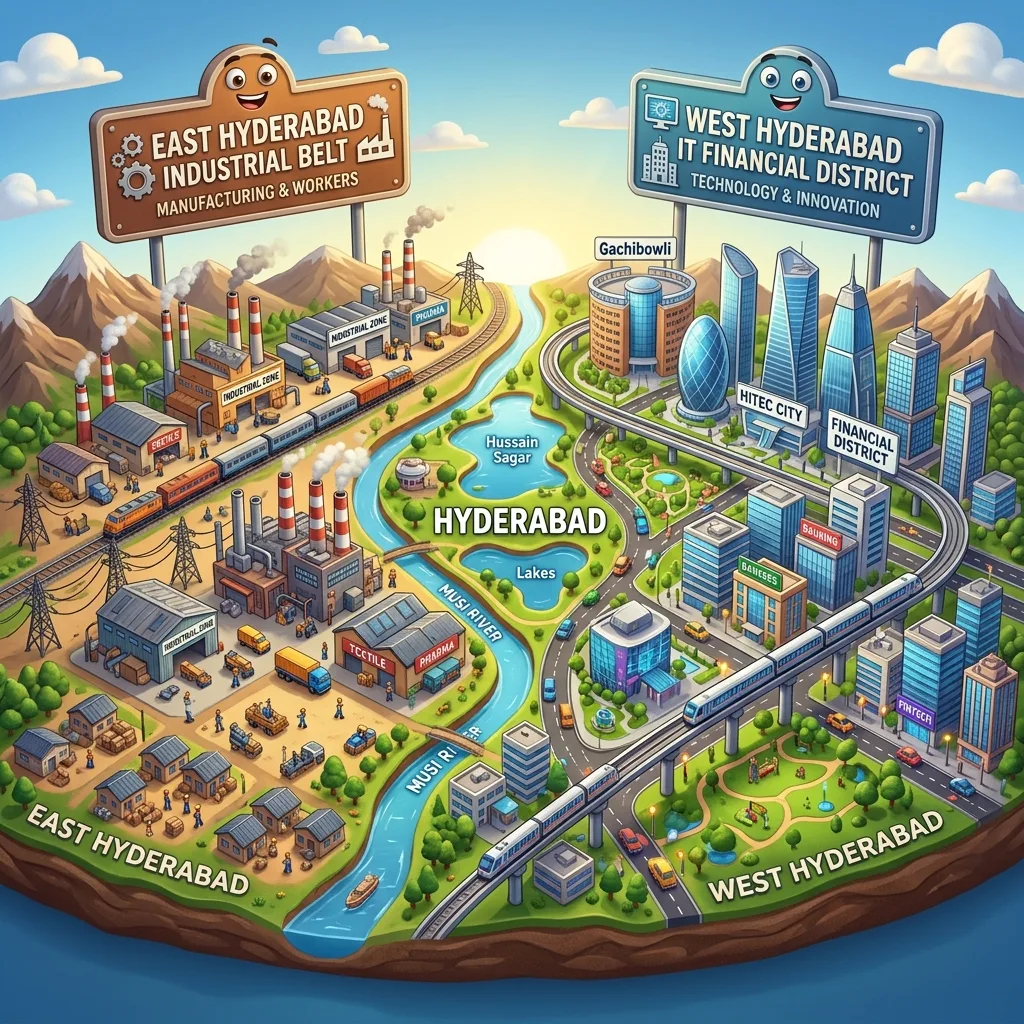
Hyderabad's airport sits south of the city, at Shamshabad, outside the Outer Ring Road. The city's densest concentration of offices sits west, along the HITEC City–Gachibowli–Financial District spine, also just inside the ring. The two are close to opposite corners of the same 158-kilometre loop, and almost every argument about direction in this city follows from that single geometry.
The ground differs too. West of the city the land climbs onto the rocky Deccan shelf — granite outcrops, tank-fed drainage, undulating farmland that opens out past Tellapur and Mokila towards Shankarpally and Kandi. East and south-east the land sits lower, towards the Musi basin and the older industrial belts along the Warangal highway, flatter and, in patches, carrying a longer history of manufacturing beneath it.
Where land is still available in large contiguous parcels is a third fact worth putting on the map before any comparison. Inside the ring on the west, it is largely gone. Past the ring, on both the western and the south-eastern arcs, it is not.
The ring is the same length everywhere; what sits under it is not
The ORR gives every corridor around Hyderabad a claim to connectivity, and marketers on all sides make it. Exit 3 on the Patancheru side serves the western plot belts; the eastern exits serve Uppal, Pocharam and Ghatkesar; the southern exits feed the airport. A ring connects places. It does not make them equivalent.
What decides value inside each arc is what the road connects you to and how far along it you have to go. From the western belt, the ring delivers you to the office core in one direction and to the airport in the other, and those two journeys are not the same length. From Shankarpally, the Financial District is roughly forty-five minutes; the airport is closer to an hour. That asymmetry is the west's shape in a sentence.
Land supply decides what can be built, not only what it costs
Price is the visible consequence of land supply. The invisible one is layout quality. A developer assembling forty or fifty contiguous acres can lay 40-foot internal roads, run water, power and drainage underground, hold back real open space and still have a viable plot count. A developer stitching together four fragmented parcels cannot, whatever the brochure says, because the geometry will not allow it.
This is why the outer arcs on both sides matter more than the inner ones for anybody buying land rather than a flat. Inside the ring on the west, assembly at that scale finished years ago; what remains is infill, and infill layouts show it in their road widths and their turning circles. Past the ring, on the western belt around Shankarpally and on the south-eastern belt towards the airport, parcels of that size still exist.
So when comparing directions, compare the physical layouts available in each, not the corridor names. Road width, drainage design and open space are decided once, at sanction, and never improved afterwards.
The west's case is a payroll that already exists
Microsoft, Amazon, Google, Apple, JPMorgan Chase and Goldman Sachs all run substantial offices in the western belt. That is not a projection. It is a payroll being paid this month, and housing demand has radiated outward from it for three decades — Madhapur, then Kondapur, then Narsingi and Kokapet, now Tellapur, Mokila and Shankarpally.
Two other things sit along that western arc and are less often counted. IIT Hyderabad is at Kandi, roughly twenty-five minutes from Shankarpally, and institutions of that kind pull research employment and staff housing behind them for decades. And the school belt around Mokila and Tellapur — Glendale, Samashti, Epistemo among them — has thickened to the point where families move for it, which is a different and stickier motive than commuting distance.
Then there is the railway. Shankarpally has a working railway station on the Hyderabad–Vikarabad suburban line. Very few plotted corridors around Hyderabad have one, and suburban rail has a habit of surviving funding cycles that road projects do not. We have written separately on what the railway station actually changes, because it is the single western asset most often left off comparison tables.
The east and south-east are running on infrastructure that is coming
The eastern flank has its own logic and it is not a poor relation. Industrial estates and manufacturing anchor a broad working population; the Warangal highway carries real logistical weight; and the Metro reaches the eastern side of the city in a way it does not reach the outer west. Entry prices sit meaningfully below western equivalents, which is a coherent reason to buy and not merely a discount.
The south-east and south are the more interesting argument. The airport is there. The state's Future City ambition is directed at that side. And the Regional Ring Road — proposed at roughly 340 kilometres, with its northern section approved as NH-161AA — would, when built, reorganise land economics wherever it lands. Buyers in that belt are underwriting infrastructure that is announced rather than operating, which is a legitimate strategy provided it is named as one.
That is the honest split. The west's case is largely built. The south-east's case is largely scheduled. Those are different risks, not different qualities, and they suit different holding periods.
There is a practical test for any scheduled-infrastructure argument, and it applies to every direction equally. Ask which specific section is approved, which is merely proposed, whether land acquisition has begun, and whether anything is visible on the ground. A buyer who can answer all four is investing. A buyer who cannot is hoping, and paying a price set by other people's hope.
What the west genuinely lacks
Three things, and no western developer including us should pretend otherwise.
The Metro does not reach the western plot corridors. It serves the inner west and it serves the eastern side of the city, but a buyer at Shankarpally has a suburban rail option and no Metro option at all. If mass transit at your doorstep is the requirement, the east answers it today and the outer west does not.
The airport is the wrong distance. From the western belt it is a real journey around or through the ring, materially longer than the office commute. For a household flying twice a month, that is a weekly-life difference, and the southern corridors simply win it.
And water sits harder on the granite shelf. Borewell yield on the Deccan rock is a parcel-level lottery, and in pockets where extraction has run ahead of recharge it is a deteriorating one. This is why we treat rainwater harvesting and underground storage at Sanctuary as engineering rather than a brochure line — 45 acres and 475 plots share a water future, and a layout that treated it as somebody else's department would age badly. Ask any western developer, us included, what the layout does about water, and do not accept an adjective as the answer.
Add a fourth, softer point: the west's road and drainage capacity has run behind its construction for years. Buying outside the ring in the west means buying some years of the ecosystem catching up.
What the east lacks, stated as plainly
Depth of high-income employment. The eastern base is broad — industry, logistics, services, institutions — and broad demand absorbs supply steadily. What it has not yet produced is the salary density that supports large villa-plot communities and international schools at western scale.
The consequence is a flatter curve. The east accrues; the west has historically re-rated in waves as employment radiates outwards. Neither is superior in the abstract, and we write no percentages here because honest ones do not exist in advance. But a buyer choosing the east should choose it for steady accrual and affordability, not in expectation of a corridor re-rating that the underlying payroll does not yet support.
The commute you choose is one you drive for a decade
Households underweight this consistently. A direction is not chosen for a year; it is chosen for the school run, the office run and the airport run repeated several thousand times. So evaluate the specific road, not the corridor.
From the western belt, the journey to the office core runs along the Shankarpally road to the ring and in through Exit 3 on the Patancheru side, or through the Mokila–Tellapur route depending on where you join. Drive it at eight in the morning and again at seven in the evening before you sign anything; the midday drive a sales team schedules is not the drive you will make. The railway station matters here as a fallback rather than a substitute — on the days the road fails, rail does not.
From the east, the equivalent journey runs inward through the Uppal side, where Metro genuinely relieves part of the load. That is a real structural advantage for a household working in the city rather than the western core, and no western argument should talk it away.
Watch where schools and hospitals sign leases
When you cannot trust marketing, watch capital that does its own research. Hospital chains, organised grocery, multiplex operators and school groups commission demand studies no individual buyer could afford, and then commit twenty-year leases against them. Their expansion maps are the best free analysis available on any corridor in this city.
The western inner corridors accumulated that institutional layer long ago, and its outward creep towards the plot belts marks where professional money expects rooftops. The east's essential coverage is broad and its higher-end layer thinner, which mirrors the payroll beneath it. Where such operators hesitate, ask why before your own capital goes where theirs would not. One opening proves nothing; a pattern of openings over a few years comes close.
Three households, three correct answers
A production supervisor working an eastern industrial campus, with family in the old city, has no dilemma. An eastern plot near work, bought carefully, serves both life and money. Metro access on that side is a genuine daily benefit, and the price advantage is real.
A two-income technology couple in the Financial District faces the western question in its pure form: pay near the core, or take land economics one corridor out and accept a commute along a road they will drive for a decade. The school belt usually decides it, because children's schooling is the least negotiable input in the equation.
An investor with no commute at all should admit they are choosing a risk profile, not a neighbourhood. Built infrastructure with an existing payroll, or announced infrastructure with a longer horizon. Our ranking of Hyderabad's plot markets works through the corridor-level version of that choice.
What we build, and what we have not announced
Next Edge Realty builds in the west, in the Shankarpally corridor, and we are not neutral about it. We think a corridor that already has the payroll, the rail station and the institutions is a shorter bet than one that is waiting for a road.
We are also developing at Mansanpally, in the southern airport and RRR belt, precisely because the second argument has merit. The details of that project — sizes, pricing, approvals, timelines — are not announced, and we will not describe them before they are. When a developer volunteers specifics about an unlaunched project, treat the specifics as marketing rather than fact, ours included.
Where we stand
Land follows payroll. Hyderabad's payroll is predominantly western today, which is why the western corridors carry the shorter, better-evidenced argument. The southern belt carries the longer one, and it may well pay more if the road and the city arrive as planned. Both statements can be true; they simply describe different holding periods.
So choose the direction by the thing you are actually underwriting, then stop comparing halves and start comparing parcels. HMDA or DTCP approval verified in the documents, title traced by your own advocate, water answered specifically, and a price you can hold through a full cycle without strain. Verification of title and approvals rests with the buyer, and property values are subject to conditions no essay can predict. If the western argument holds up for you, arrange a site visit or talk to us — and if the eastern one does, we would rather you bought well there than badly here.