
Hyderabad's Industrial Belts and the Land Beside Them
Patancheru's name still carries an environmental record. For years it was among India's more heavily documented industrial pollution cases, with a litigation trail anyone can read. Any account of West Hyderabad's industrial geography that skips that is not an account. It is a brochure.
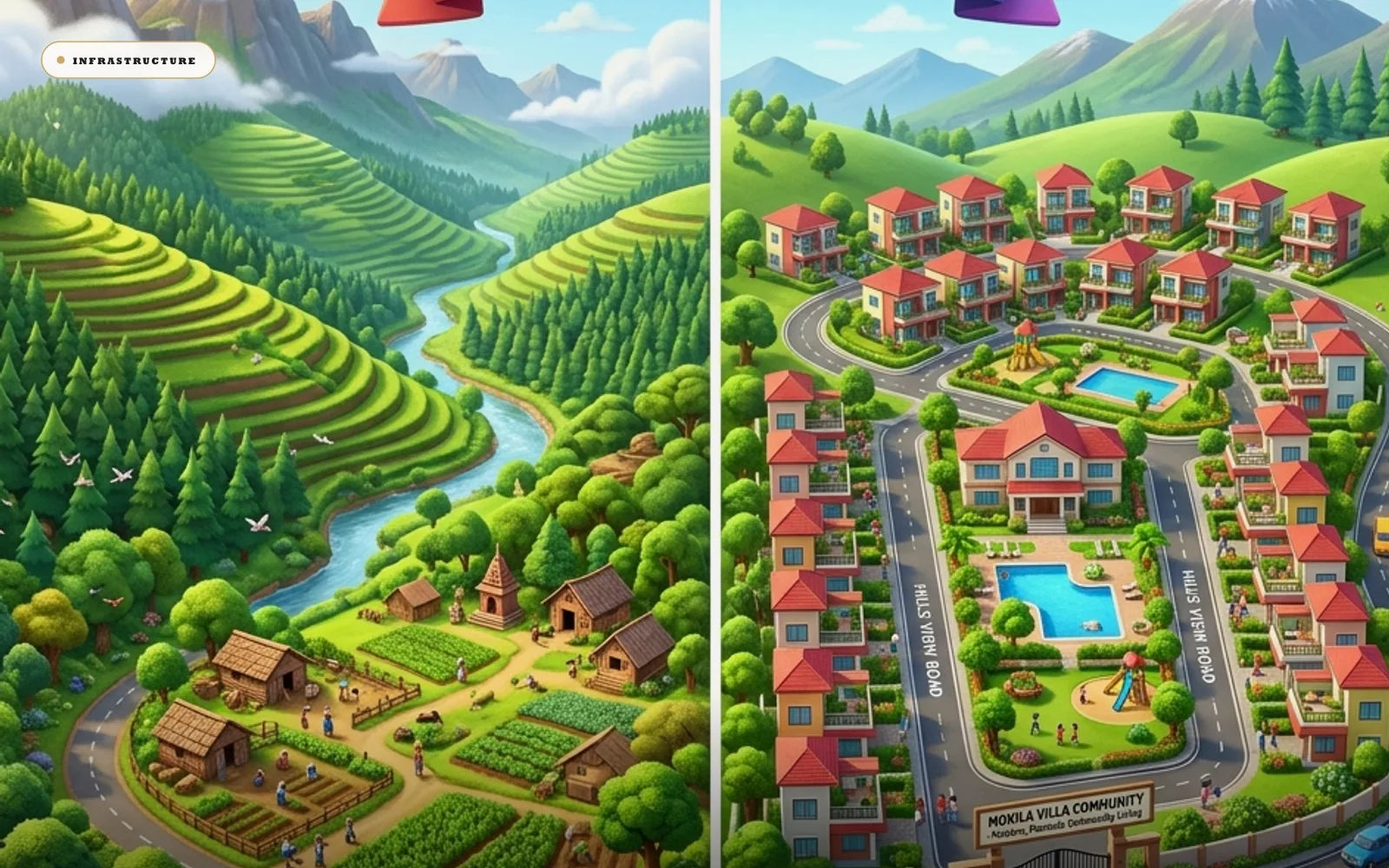
Patancheru's name still carries an environmental record. For years it was among India's more heavily documented industrial pollution cases — effluent discharge, contaminated groundwater in surrounding villages, litigation that ran through the courts and left a paper trail anyone can read today.
Any account of West Hyderabad's industrial geography that skips that is not an account. It is a brochure. So start there, because the honest version of this subject produces a better buying rule than the flattering one.
The record, and what has changed since
The problem at Patancheru was not that industry existed. It was that a dense concentration of chemical and pharmaceutical units discharged into a watershed with inadequate treatment, for long enough that the effects reached groundwater and agriculture downstream.
What followed was a long and uneven correction: court orders, common effluent treatment infrastructure, conveyance systems to move treated effluent away from local water bodies, tighter consent conditions, and considerably more monitoring than existed when the belt was formed. Industry there today operates under a regime that did not exist when the damage was done.
Two honest conclusions follow. The situation is materially better than it was and continues to be regulated. And a legacy of this kind does not fully disappear from soil, groundwater or local memory within a generation, which means a buyer should treat the area's water with specific rather than general curiosity.
That second conclusion is the useful one, and it generalises. Near any industrial belt, the question is not whether industry is present but what it discharges, where that goes, and how far you are from the path. We deal with this belt in more detail in the Patancheru industrial corridor.
The buffer principle is written into the zoning and it is readable
The good news for a careful buyer is that this problem has already been thought about by planners, and the thinking is on paper.
Master plans and zoning regulations distinguish industrial from residential land use and provide for separation between them. Certain categories of industry carry siting restrictions. Buffers exist around specific installations. None of this is discretionary or invisible — it appears in the land-use plan applicable to a parcel, which is a public document.
So the practical rule for anyone buying near an industrial geography is simple to state and rarely followed: read the land use of your parcel and of everything adjoining it. A residential plot in an approved layout, separated from an industrial zone by a buffer and by distance, is a different asset from a residential-looking plot sitting beside or inside an industrial land-use polygon. The second may be cheaper. It is cheaper for a reason, and the reason will still be there when you try to sell.
Prevailing wind direction and downstream water flow are worth establishing too. Both are answerable in an afternoon, from public sources and from talking to farmers who have worked the land for thirty years.
The old belt is the west's oldest payroll
Set the caution aside for a moment and note what the western industrial belt actually is.
Patancheru and the corridor around Sangareddy carry decades of industrial establishment — pharmaceutical manufacturing, engineering, chemicals, and the ancillary and logistics businesses that cluster around them. This predates the technology boom by a long way. It was the region's employment base when HITEC City was a rocky field.
That matters for a residential land buyer in a specific way. The western flank has a payroll uncorrelated with software hiring. Industrial employment tends to be less volatile than technology employment, less sensitive to global sentiment, and rooted in fixed plant that cannot be relocated on a quarterly decision.
The ORR's Exit 3 on the Patancheru side serves both this belt and the residential corridor beyond it — a connection we examine in what the Exit 3 corridor connects.
It matters, too, that this employment is old. An industrial belt that has operated for decades has already produced its schools, its clinics, its bank branches and its repair economy. A residential corridor forming beside a mature industrial area inherits services that a corridor forming beside a greenfield announcement will wait years for.
Life sciences is the state's signature cluster
Telangana's pharmaceutical and biotechnology sector is a national cluster rather than a regional one, and Genome Valley on the city's northern side is its most visible expression — a concentration of research facilities, laboratories and life sciences manufacturing developed as a purpose-built cluster.
Two features of this sector make it interesting for land analysis.
It is capital-intensive and heavily regulated, which makes facilities sticky. A licensed manufacturing plant with regulatory approvals attached to a specific site does not relocate casually. Sunk, licensed capacity is the most durable kind of employment there is.
And it employs across the skill range, from doctorate-level research staff to production and quality personnel, which produces housing demand across several price bands rather than only at the top. Corridors near life sciences clusters therefore tend to develop a broader residential mix than corridors serving a single-tier white-collar employer.
Aerospace, defence and the newer clusters
Hyderabad has developed aerospace and defence manufacturing capability, with a cluster on the southeastern side of the city and a supplier ecosystem attached to it. Precision engineering of this kind shares the stickiness of life sciences: certifications, tooling and skilled workforces are location-specific and expensive to move.
Further west, the announced National Investment and Manufacturing Zone at Zaheerabad sits on the axis running out beyond Sangareddy. Large industrial zones of this type have long gestation periods and should be treated the way we treat any announced project — as optionality that firms up when land is acquired, infrastructure contracted and anchor units commit, and not before.
The general point is that Telangana's industrial policy has pursued several distinct sectors rather than one. Whether each individual initiative succeeds is uncertain. That the strategy is diversified is not.
What industry mechanically does to residential land
Strip the sentiment out and industrial geography affects residential land through four mechanisms.
Payroll within commuting distance. Managers, engineers, quality staff and administrators want decent housing near work, and their preferences resemble those of any professional household. This is the demand channel, and it is why corridors adjacent to industrial belts develop residential markets at all.
Road and utility infrastructure. Industrial areas get power, water and freight-grade roads because factories require them. Residential development beside an industrial belt inherits infrastructure it did not have to lobby for.
Land-use exclusion. Industry occupies land that is then unavailable for housing, which concentrates residential demand into the remaining developable pockets. This is a price-supporting effect most buyers never think about.
Externalities. Noise, air quality, effluent, and heavy vehicle traffic on shared roads. These reduce residential desirability as a function of proximity — sharply within a short radius, negligibly beyond it.
The buying rule follows from all four operating together. You want the first three and not the fourth, and the way to get that combination is distance with connection: residential land near enough to the belt to share its infrastructure and its payroll, far enough that the externalities do not reach you. Near industry, not in it.
How to read an industrial announcement as a landholder
Industrial news arrives constantly and most of it should change nothing about your decisions. Here is how to sort it.
Distinguish announcement from commitment. A memorandum of understanding is a press release. Land allotted, environmental clearance obtained, construction started and hiring begun are facts. The gap between the two is where most disappointment lives.
Ask what kind of industry it is. A software development centre, a pharmaceutical formulation plant and a bulk drug unit have entirely different externality profiles. The category tells you more than the investment figure does.
Ask where the workforce will live, and whether that place has legal residential supply. An industrial announcement without adjacent approved housing capacity produces less residential value than one where the supply already exists.
And check the alignments. Freight roads, rail sidings and utility corridors serving new industry sometimes run through land that residential buyers had other plans for. An approved alignment crossing a parcel is a material fact and it is findable before you buy.
The logistics layer is industry's quiet companion
Warehousing and freight rarely feature in residential analysis, and they should, because they behave differently from factories and they arrive faster.
Logistics follows ring roads and national highways rather than industrial estates. A closed 158-kilometre ORR with graded interchanges is exactly the geometry that warehousing wants: reach the whole city without entering it. Distribution centres, cold chain facilities and third-party logistics operators have consequently taken land along the ring's arcs and the highways feeding into them.
For a residential buyer this cuts both ways, and the honest account gives both sides.
On the favourable side, logistics generates employment across skill levels, brings power and road upgrades with it, and does not produce the effluent or air quality issues that heavy manufacturing can. It is a comparatively benign neighbour at a distance.
On the unfavourable side, it produces heavy vehicle traffic, and heavy vehicle traffic on a road you also use for a school run is a genuine and permanent cost. Warehouses run at night. Trucks queue. A two-lane approach road shared between a distribution cluster and a residential layout degrades quickly, and widening arrives late.
The check is specific: find out what sits on the road between your layout and the arterial, and drive that road at seven in the morning and again at nine at night. Freight traffic is invisible on a Sunday afternoon site visit, which is when almost everybody visits.
Diversification is the actual dividend
Here is the argument that survives all the caution above.
A residential corridor whose demand rests on one industry is exposed to that industry's cycle. West Hyderabad's plotted belt is often described as a technology suburb, and if that were the whole picture the exposure would be uncomfortable.
It is not the whole picture. Within a reasonable radius sit software employment to the east, pharmaceutical and engineering industry to the northwest, life sciences at national scale in the region, an IIT campus at Kandi, and the logistics layer serving all of them. Those payrolls do not move together. They hire different people, they fail at different times, and they respond to different global conditions.
That is the industrial map's real contribution to a residential land thesis. Not a story about any single factory, but a broader base under the demand. It does not eliminate the concentration risk — software salaries still set the ceiling on what plotted stock in this corridor commands — and it meaningfully raises the floor.
Both our western projects sit in that position: Sanctuary on 45 HMDA-approved acres at Julkal, and Raghunath County on 19 DTCP-approved acres facing the Shankarpally–Mehtabkhan Guda–Mominpet main road. Residential land use, approved layouts, and connection to the industrial west without sitting inside it.
Read the wind and the water before you read the brochure
Before buying anywhere near an industrial geography, do four things.
Pull the land use of your parcel and of every parcel adjoining it, and read what the applicable plan permits on each. Establish which way the prevailing wind blows and what sits upwind. Establish where surface water and groundwater flow from and to, and what is upstream. And ask farmers who have worked the surrounding land for decades what they have seen — they are the most under-consulted source of environmental history in Indian land buying, and by far the cheapest.
Then decide. Industry near a residential corridor is an asset. Industry inside one is a discount you pay for twice, once in quality of life and again at resale. Investments remain subject to market conditions, and verification of title, approvals and land use stays with the buyer. Our investment page sets out the wider framework these checks belong to.