
How Land Appreciates: What West Hyderabad's Decade Taught
Rewind ten years and Kokapet was quarry land, Mokila was farms with a few gated projects, and Shankarpally was a market town with a railway station. The sequence by which that changed is the most useful thing Indian real estate has published in a decade.
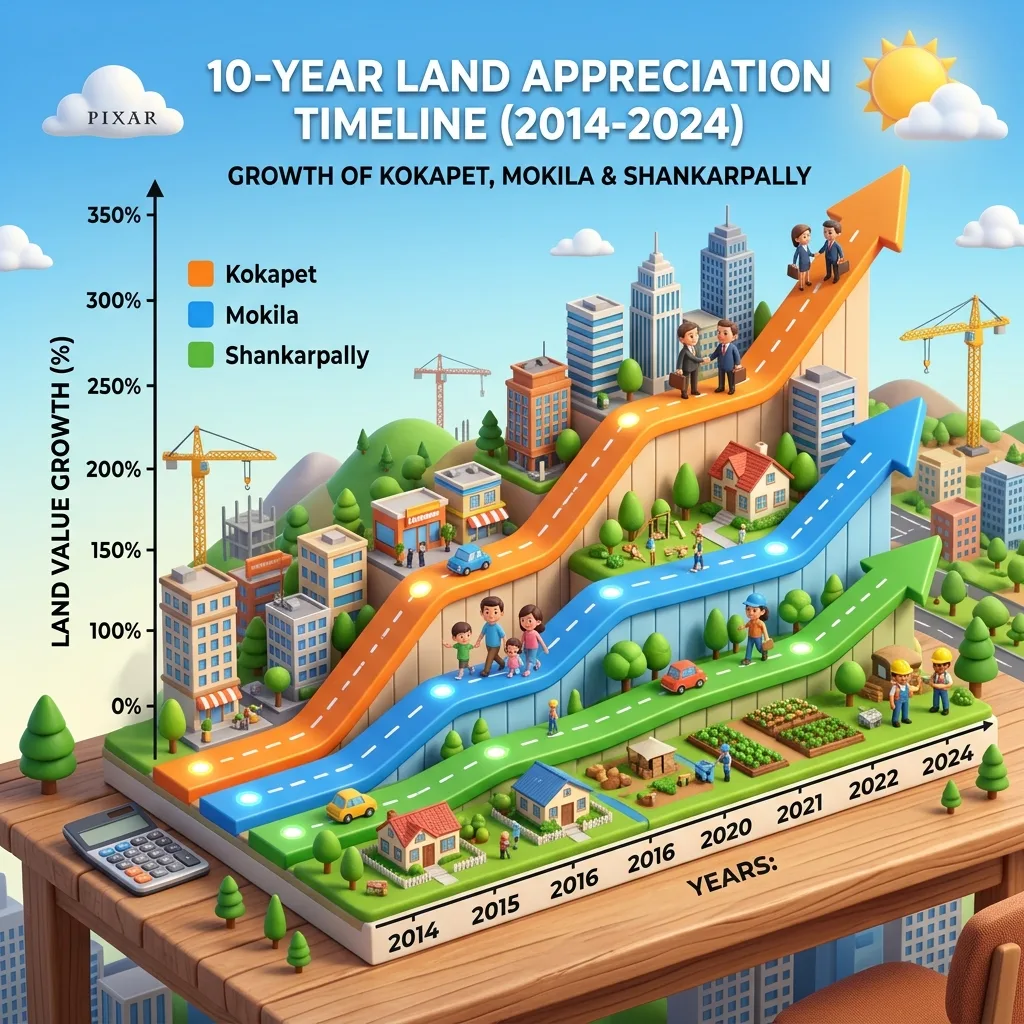
Rewind ten years and stand at the western edge of Gachibowli. Nallagandla was filling out. Tellapur was mostly plots and hoardings. Kokapet was quarry land beside a new ring road. Mokila had farms and a handful of gated villa projects proving a theory. Shankarpally was a market town with a railway station and no villa market to speak of.
A decade later Kokapet's parcels were auctioned in public at levels that made national news, Tellapur had verticalised, Mokila had filled with villas and international schools, and the frontier of approved, affordable plotted land had moved west to the Shankarpally corridor.
The repricing did not happen evenly or at once. It happened in a sequence, and the sequence, not any single price move, is what a buyer should learn.
Appreciation is repricing, and the land itself does nothing
Strip away the mystique. A parcel is worth what the marginal buyer will pay for the bundle of possibilities it carries — the homes that could stand on it, the commute it enables, the schools it reaches. When any of those possibilities improves, the parcel reprices upward without changing physically at all.
That is the strangeness of land as an asset. A factory must produce. A company must grow profits. A plot must merely be in the way of the future. The skill is therefore positional rather than operational: judging where the future is headed and arriving before it does.
Phase one pays the most and fails the most
Every corridor's story begins with words rather than concrete. A ring road is proposed. A financial district is master-planned. A policy designates a growth direction. Land is cheap in this phase because the future is only claimed, and claims are plentiful.
The Outer Ring Road was once such a claim. So was the Financial District. Buyers who took western land then carried genuine risk, because some announcements die, and were compensated with the largest proportional gains of the whole cycle.
The lesson is not to buy every announcement. It is that announcement-phase pricing is the only phase where the entire future is available at a discount, and that the discipline lies in choosing announcements with economic necessity behind them rather than political enthusiasm. The Regional Ring Road, proposed at roughly 340 kilometres with its northern arc approved as NH-161AA, is currently mid-transition from announcement to approval, and land along its western reaches is priced with corresponding scepticism.
The surest gains clustered around delivery, not announcement
When machinery replaces press releases, land reprices a second time, often more sharply, because uncertainty collapses.
The ORR's completion was the west's great delivery event. A 158-kilometre access-controlled ring converted vague future connectivity into a measurable drive time. Corridors near its western exits — including Exit 3 on the Patancheru side, which serves this belt — became commutable, and their land markets knew it within a season.
Delivery also arrives in quieter forms. Shankarpally's railway station is delivered infrastructure. IIT Hyderabad's campus at Kandi, about twenty-five minutes away, is delivered infrastructure. Each such fact removes a reason for the marginal buyer to hesitate, and hesitation is what keeps prices low.
Investors habitually overvalue announcements and undervalue delivery, because announcements are exciting and delivery is gradual. The decade's evidence runs the other way.
Schools change who buys, not just how much they pay
The third repricing is the least discussed and the most durable. It happens when institutions commit — schools above all — and end-user families follow.
The Mokila–Tellapur belt shows it plainly. Campuses of reputed schools such as Glendale, Samashti and Epistemo turned a plotted landscape into a place families could imagine raising children, and the buyer profile shifted from traders to households.
That shift changes the character of a land market rather than merely its level. Traders sell on any wobble. Families hold through cycles because they live there or intend to. A corridor that completes this phase acquires a demand floor no purely speculative market possesses. Watching where school groups, hospitals and organised retail commit capital is therefore the cheapest research available — those institutions run demand studies, and you can read their conclusions in their actions.
Arrival is a triumph for early owners and a constraint for new money
Eventually a corridor finishes becoming and simply is. Tellapur's towers, Nallagandla's full streets, Kokapet's auction headlines.
Nothing is wrong with an arrived corridor. They are pleasant to live in and safe to hold. But land there now trades at prices that already contain the future, so returns compress towards the city's general growth rate. The decade's arithmetic is blunt: the multiple was earned between the first and third phases, not after the fourth. New capital seeking the same journey must find a corridor still travelling through the early phases, which is the analytical case set out in why invest in Shankarpally.
Infrastructure pays twice, with a long tradeable gap between
The decade shows infrastructure rewarding landowners at two distinct moments — once at credible announcement, once at delivery — with a long interval in between during which very little visible happens.
An investor who missed the ORR's announcement era could still have bought before its network effects matured and done well. The RRR now offers the same two-stage structure to the patient: approval milestones first, construction and completion later, each with its own repricing. What it does not offer is a date, and any seller who supplies one is inventing it.
The frontier moves along roads, not in circles
Growth did not radiate evenly from HITEC City. It flowed along specific corridors — the ORR's western exits, the Gachibowli–Shankarpally axis, the routes towards institutions. Land two kilometres off a growth road can sit still for years while parcels on the road multiply.
The practical test for any plot: name the road that connects it to the city's economy, and ask what is scheduled to happen to that road. A layout such as Raghunath County, fronting the 100-ft Shankarpally–Mehtabkhan Guda–Mominpet road, is that lesson applied in a single decision.
Regulation raised the floor under approved land only
The decade coincided with Telangana's regulatory modernisation: RERA registration, streamlined building permissions through TS-bPASS, and the consolidation of layout approvals under HMDA and DTCP.
The effect on values was quietly profound. Buyers could trust the asset class more, lenders could finance it more readily, and the discount once demanded for legal uncertainty narrowed. But the benefit accrued unevenly, and only to approved layouts. Unapproved ventures were left further behind than before, precisely because a regulated alternative now exists at scale. The appreciation story of the decade is really the story of approved land.
A plotted layout is supply that is sold once
Corridors that permitted unlimited tower construction saw price growth repeatedly interrupted by their own inventory. Plotted corridors behaved differently. An approved layout is a fixed quantum of supply — sold once, never reissued — so price discovery happens against genuinely finite stock.
This is a structural advantage, not a guarantee. A plotted corridor can still stagnate if demand fails to arrive. What it cannot do is flood itself.
Nobody compounded through the decade by trading
Stamp duty, registration and search costs punish churn. The biggest moves came in clusters, around deliveries and institutional commitments, that no trader could reliably time.
The owners who captured the full cycle did something almost embarrassingly simple. They bought sound, approved land early on a growth road, and then did nothing for years. We set out that temperament in full in the land banking playbook.
Two ways this model misleads
The first failure mode is the announcement trap. Not every proposal carries economic necessity behind it, and corridors have been marketed around infrastructure that existed chiefly in brochures. Buyers who paid future prices for imaginary futures waited years for a repricing that never came. The antidote is to ask what forces a project into existence. The ORR was compelled by a city choking on its own growth. An announcement with necessity behind it can be delayed; it is rarely abandoned.
The second is arrival extrapolation — assuming that because Kokapet's auctions cleared at extraordinary levels, any land vaguely west of the ORR deserves a fraction of those prices. Appreciation does not seep uniformly across a map. It follows roads, approvals and institutions, parcel by parcel. Two plots a kilometre apart can live in different decades: one on a widened main road inside a sanctioned layout, the other behind a village lane with agricultural paperwork.
What did not appreciate, and why
A decade of winners is only half the record. The parcels that went nowhere are more instructive, and they fall into recognisable groups.
Land behind an unmade access road. The parcel itself may be perfectly good, but a buyer who cannot reach it in a car in the monsoon will not pay for it, and the road is somebody else's responsibility for as long as it takes.
Land in unapproved layouts sold on the promise that regularisation was imminent. Some of it waited the whole decade. Approvals are granted to layouts that comply, not to layouts that have waited a long time.
Land with a clouded title — an unresolved succession, a missing link document, an old agreement of sale that never went away. This land trades, but at a discount that never closes, because every subsequent buyer discovers the same problem and applies the same deduction.
And land bought at future prices in the announcement phase of a project that did not proceed. Nothing about that parcel is defective. It simply had its future paid for in advance by its previous owner.
Three of these four failures are visible before purchase, to anyone who walks the access road, checks the sanction and instructs an advocate.
What a morning on the corridor tells you that a price list cannot
Price data lags reality by months. The ground does not. Investors who read the west correctly tended to be the ones who drove it regularly, watching for the small signals that mark a corridor's movement between phases.
School buses on rural roads are one — evidence that families rather than registrations have arrived. Compound walls and entrance arches rising on former farmland. Borewell rigs and electricity poles marching outward. A pharmacy or supermarket where a tea stall stood. Construction crews inside layouts sold two years earlier, which shows buyers converting plots into homes rather than flipping paper.
Each signal is individually small. Together they date-stamp a corridor's phase more accurately than any listing portal.
One counter-signal belongs on the same list. A corridor where the same plots are advertised by three different brokers, month after month, at slowly softening asking rates, is a corridor whose registered transactions have stopped even though its hoardings have not. Listings are cheap to maintain. Registrations are not.
What the next decade asks of the model
Project it forward and the outline is visible. The employment core continues to anchor demand. The RRR moves from approval towards delivery, performing for the outer west what the ORR performed for the inner west. The Shankarpally corridor, already carrying delivered rail, ORR access, schools and an IIT within reach, works through its institutional phase. New frontiers open along other infrastructure — the airport and RRR corridor to the south, where our upcoming Mansanpally project sits.
None of this is guaranteed. Real estate remains subject to market conditions, verification of title and approvals is the buyer's responsibility, and the model asks the future to keep doing roughly what it has done for twenty years — which is an assumption, not a fact.
Use the model as a filter rather than a forecast. Identify the employment engine and the roads that feed it. Find the corridor still in its first three phases. Buy only approved, finite supply on the growth road. Then give the position the years it needs, and spend one of the early mornings walking it — book a site visit and read the corridor's phase off the ground yourself.