
The Four-Minute House Tour: Luxury, West Hyderabad Version
The house tour lasts four minutes and nothing expensive is pointed at. What gets shown is the courtyard, a mango sapling, the study with north light, and the street where children were cycling at dusk. That inventory is the argument.
The house tour lasts four minutes. Nothing expensive is pointed at.
What gets shown is the courtyard where breakfast happens, a mango sapling that will shade a car in a decade, the study with the good north light, and the street outside where the children were cycling unaccompanied at dusk. The family could have bought anything. They bought this, forty-five minutes west of the Financial District, and the shortness of the tour is the whole point.
Every wealthy city eventually has this conversation with itself. The first generation of money buys visibility. Then the people who have arrived stop needing to announce it, and what they want instead turns out to be embarrassingly simple: space, quiet, light, trees, time. The arc from Kokapet and Tellapur out through Mokila to Shankarpally is where Hyderabad is currently having that conversation.
The loud years built the city and earned their chandeliers
Let us not be ungrateful. HITEC City and the Financial District assembled, within two decades, one of Asia's great concentrations of technology employment. Microsoft, Amazon, Google, Apple and the global banks all planted flags. The towers that followed housed a generation's arrival into prosperity, and the marble lobbies were paid for honestly.
Maturity has different economics. The core grew dense and the land beside the offices grew expensive — the government's own auctions at Kokapet's Neopolis said so in public — and the tower's proposition began to invert. Buyers started asking what exactly was luxurious about paying more to share a wall, a lift lobby and a pool schedule with four hundred households at the noisiest intersection of the commute.
Land is the item that cannot be manufactured or shared
Watch what Hyderabad's established professionals are actually buying in the corridor around Shankarpally and you can reconstruct their definition item by item. It is a strikingly unphotogenic list, and it begins with the ground itself.
A plot of 200 to 750 square yards — the range across Sanctuary's forty-five acres — is not a unit in a structure. It is a piece of the earth's surface with your name in the registry. Every other item on the list depends on this one. Freedom to build as you wish, garden as you wish, extend for a grandparent or a grandchild: these are capabilities rather than features, and only land confers them.
Silence is the amenity nobody prices
Past the ORR's Exit 3 the ambient roar of the city falls away. What replaces it is what buyers mention unprompted after a first morning visit: birdsong, wind through avenue trees, the temple bell from Shankarpally town.
Chronic noise is a health cost rather than a nuisance, and its absence is a daily dividend no clubhouse can substitute. It is also the one thing a brochure photograph cannot carry, which is why you have to stand there to understand what is being sold.
Test it at the right hour, though. A layout is quiet at eleven on a Sunday morning by definition. Go back on a weekday, stand at the plot boundary, and listen for what actually reaches it: the arterial road, the quarry, the highway a kilometre off whose sound carries further at night than anyone expects.
An avenue plantation is a cathedral of shade in fifteen years
Trees are the item that most rewards thinking in decades and most punishes impatience. A plantation laid down today is shade in fifteen years, and it cannot be retrofitted at any price.
The families planting gardens on their own plots along this corridor are making the least liquid and most certain investment available: time, converted into trees. They will spend a decade watching saplings before any of it looks like the photographs.
Wealth's final purchase is time, and geography is how you take delivery
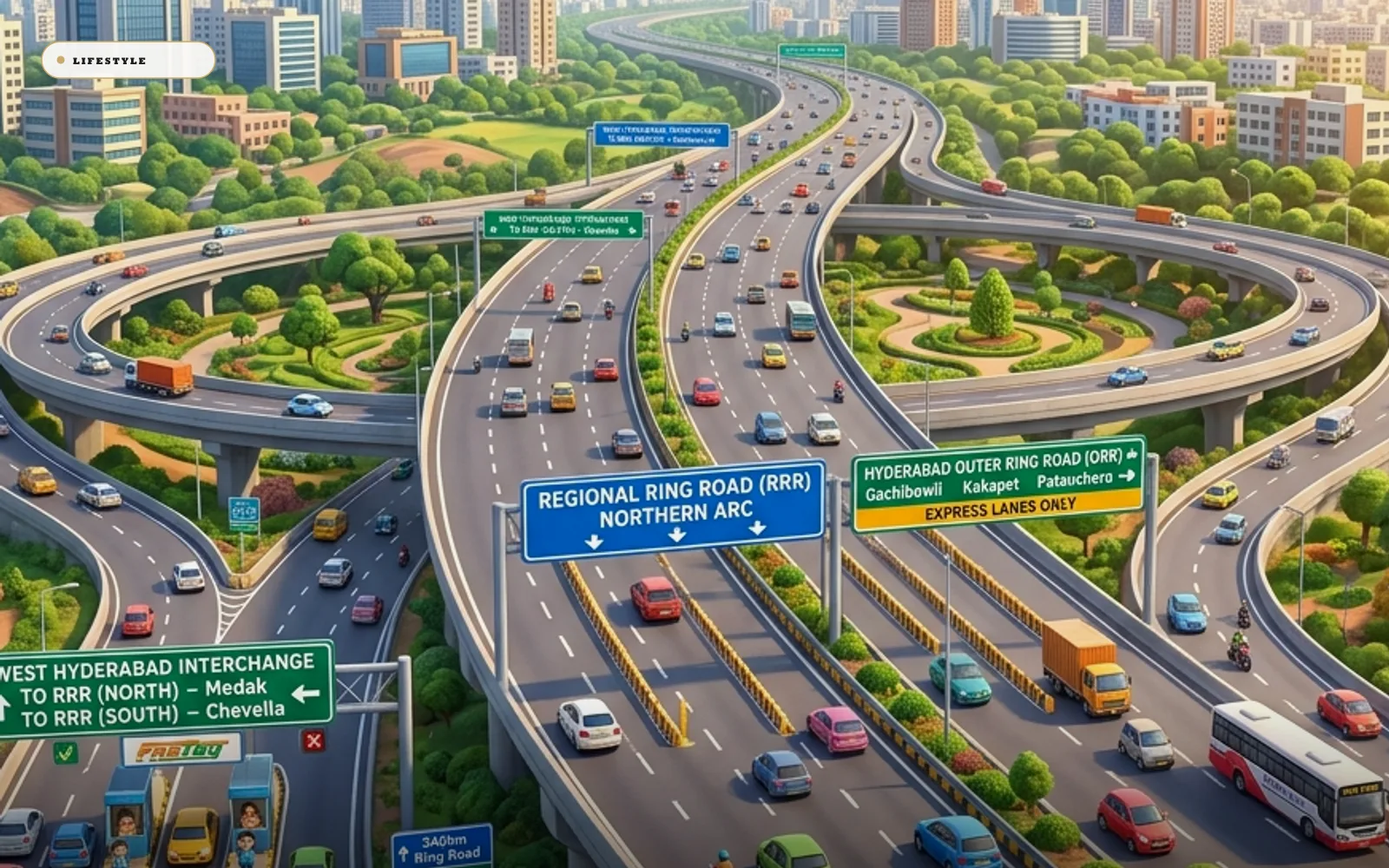
The Financial District is roughly forty-five minutes away. Suburban trains from Shankarpalli station offer a slower, calmer alternative on their own timetable. The airport sits an hour or so south, with the proposed Regional Ring Road promising to redraw regional connectivity again at some future date nobody can name.
But the deeper arithmetic is not the commute. It is everything around it. School runs measured in minutes on the Mokila–Tellapur education corridor. Weekend leisure at the community's own clubhouse rather than across town. Evenings that start at six rather than eight.
Be honest about the other side of that ledger. Two or three office days a week still put three hours on the road, and anyone weighing this corridor should drive the route at half past eight on a working morning before falling in love with the birdsong.
The houses have turned inward
The architecture rising on these plots is calm and interior-facing: courtyards, honest brick and stone, deep verandahs, one generous volume instead of five gilded ones. We document the shift in our survey of the new villa design.
It is domestic architecture with nothing to prove. Rooms composed for the family's own mornings rather than for a visitor's approval. That, more than any material, is the aesthetic signature of the corridor.
The mature buyer reads documents, not renders
There is one more marker, and it is the least glamorous. An appetite for diligence.
In this corridor that means caring about the letters before the project name — HMDA approval for a layout such as Sanctuary, DTCP for one such as Raghunath County — and about the unromantic engineering underneath: underground utilities, engineered drainage, rainwater harvesting, roads built to last rather than built to photograph.
It means independent verification of title and approvals as routine, which remains the buyer's responsibility whatever any developer says, including this one. And it means accepting plainly that property values are subject to market conditions rather than to anyone's enthusiasm.
This is not the opposite of romance. It is what makes the romance durable. The most luxurious feeling in real estate is not the first walk across the land. It is the untroubled sleep of the years afterwards.
The corridor is mid-sequence, and that is the awkward part
Corridors acquire their conveniences in a predictable order: roads, then rooftops, then retail, then restaurants. This one is visibly in the middle of that sequence, and an honest account has to say what that means day to day.
It means several years of living beside other people's construction — cement dust, lorries, the sound of a slab being poured two plots away. It means some errands still require a drive, and that the range of restaurants would embarrass a Jubilee Hills resident. It means the avenue trees are adolescent and the shade is theoretical.
What exists already is substantial: schools of genuine reputation along the Shankarpally–Mokila–Tellapur belt, supermarkets and clinics, weekend markets, the suburban rail line for an unhurried commute, and community management that absorbs the tankers-and-generators anxieties of an earlier era. But the corridor is arriving rather than arrived, and that is precisely the trade. The buyer who waits for it to be finished pays for the privilege of certainty.
A house costs more to run than a flat, and nobody says so at the site visit
The brochure conversation stops at the plot price. The household conversation should not.
A villa on 300 square yards has a garden that needs watering and cutting, a compound that needs painting, a terrace whose waterproofing has a life, a sump and pump that will fail at some point, and a gate that somebody has to open. An apartment outsources all of this into a monthly figure. A house does not; it converts it into your problem, your staff and your Saturdays.
Most households here settle into a version of the same arrangement: a gardener two or three days a week, a maid, occasionally a driver, and a relationship with an electrician and a plumber who will actually come. Community management covers the perimeter, the streets, the water and the security. The rest is yours.
None of this is a reason to avoid the format. It is a reason to cost it honestly before you commit, alongside the construction budget and the years of design decisions that precede a finished house. Owning ground is a capability, and capabilities require running.
Health is the invisible line item
If quiet luxury has a currency beyond time, it is physiology. The medical literature has been converging for two decades on conclusions every grandmother held by instinct: chronic noise and congestion tax the cardiovascular system, green views lower stress, walkable routines outperform gym memberships, and sleep in dark silent rooms is the foundation the rest of health sits on.
Read that against the corridor's inventory — low ambient noise, avenue plantation, internal streets safe for a daily walk at any age, night skies dark enough to notice — and the geography starts to look like a health instrument.
The villa format participates too. Ground-contact living, a garden that demands an hour of pottering, stairs climbed as a matter of course, courts and pool a walk away at the clubhouse. The architecture prescribes movement the way towers prescribe lifts.
The neighbours are the amenity, and they are also the risk
In a tower, the building fills whether or not you like the people in it. In a plotted community, who else buys decides what the place becomes, and a half-sold layout is a quieter proposition than the render implies.
An under-occupied community is a real outcome, not a hypothetical. Streetlights on empty plots, a clubhouse used by nine families, security patrolling a grid of compound walls, and a maintenance corpus stretched across too few contributors. It is not dangerous. It is simply not the neighbourhood anyone was shown.
The checks are straightforward and rarely made. Ask how many plots have sold and how many owners have started building. Walk the internal roads on a Sunday and count occupied houses. Ask what the maintenance charge is, who collects it, and what happens to the arrangement when the developer eventually hands over to a residents' body.
A community that answers those questions without hesitation is telling you the most useful thing available about how the next ten years will feel.
The NRI household's brief is answered by the same list
One constituency reads this corridor with particular clarity: the household abroad planning a return, or planting a flag for one. From Dallas, Dubai or Singapore the brief is distinctive — a purchase made at a distance, years ahead of occupation, in a market that must hold its order while the owner is eleven time zones away.
Everything above doubles as an answer. Approved layouts with documented title suit remote diligence. A gated, maintained community keeps the asset dignified through years of absence. Land waits without the depreciating machinery a locked apartment carries. The eventual house can be designed by video call and built under a community's watchful order.
Purchases by NRIs are routine and FEMA-compliant in this market, and the pattern has a shape: plot registered this year, built upon at leisure, occupied at retirement or at the children's schooling age. Our investment overview covers the financial mechanics.
What this is not
Quiet luxury is not austerity. The villas here are generously sized and unapologetically comfortable; the restraint is in the announcement, not the substance.
It is not remoteness romanticised. A corridor forty-five minutes from one of Asia's great employment cores, with rail, ring road and schools in place, is not a retreat from the world.
And it is not a product that can be bought finished. That is the deepest distinction. Loud luxury is delivered on possession day, chandelier included. The quiet kind is co-created: the buyer supplies patience, taste and a decade of growing trees, and the developer supplies the ground, the order and the infrastructure on which those investments can compound. It cannot be counterfeited, and it also cannot be hurried.
The raw material is still priced as a beginning rather than a trophy — Sanctuary's plots start at ₹45 lakh — and it is best evaluated the quiet way. On foot, in the morning, with your own ears doing the due diligence. Book the site visit, and bring somebody who will ask the awkward questions.