
Count the Plot Corridors With a Railway Station
Count the villa-plot corridors around Hyderabad with a working railway station in the town itself. The count is short. That anomaly is the most structurally interesting fact about Shankarpally — and it is oversold by brokers and dismissed by sceptics in equal measure.
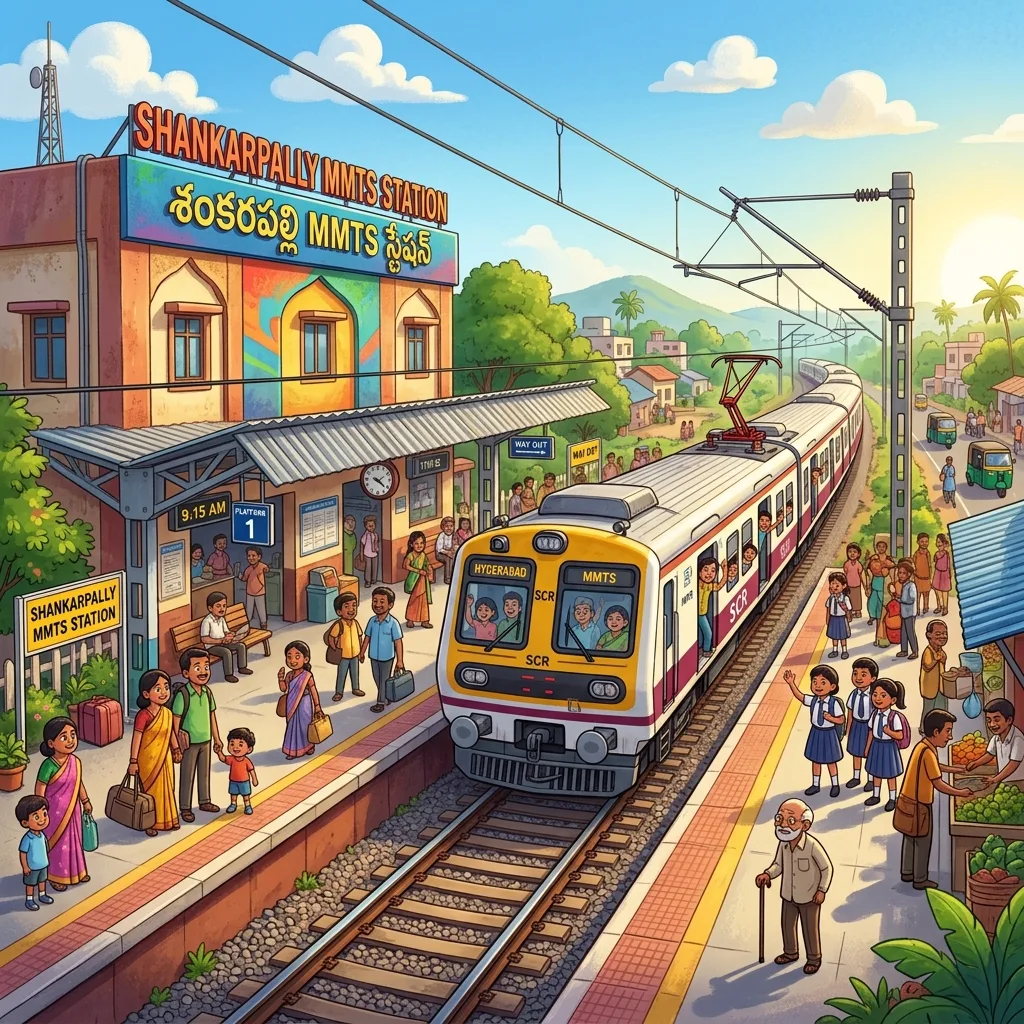
Count the villa-plot corridors around Hyderabad that have a working railway station in the town itself. The exercise is brief.
Mokila, the plotted fringes of Tellapur, Kollur: road-served only. The green belt to the south-west has no line. Much of the southern airport corridor likewise depends on highways. Shankarpally, almost alone among the serious plot markets, has a functioning station on a functioning line.
We build in this corridor, so our interest is on the table. What follows is the analysis that the brokers who oversell the station and the sceptics who dismiss it both tend to skip.
Expecting a metro is the wrong expectation
Shankarpalli railway station — code SKP — sits on the South Central Railway line from Hyderabad towards Vikarabad, served by conventional suburban and passenger trains on Indian Railways infrastructure. It shares tracks with long-distance traffic. Its frequencies are suburban-rail frequencies. Its station is a railway station. One clarification the corridor's marketing routinely blurs: MMTS, Hyderabad's Multi-Modal Transport System, does not run here today — its western reach ends at Lingampally and Tellapur, and the extension towards Shankarpalli has been demanded and surveyed but not built.
That will sound deflating only to someone expecting the wrong thing. Suburban rail's virtues sit elsewhere: enormous carrying capacity, trivial per-journey cost, immunity to road congestion, and permanence. A rail alignment through a town is a century-scale commitment. Whatever else changes in the corridor, the line and the station stay where they are, and networks built on Indian Railways infrastructure tend to be upgraded over decades rather than abandoned.
Markets price categories, and this parcel sits in the wrong one
Anomalies matter because markets price categories rather than exceptions. "Outer-west plot corridor" is priced as a road-dependent category. Shankarpally sits inside that price while quietly holding an asset the category lacks.
Whether the gap closes, and when, we will not pretend to know. But buying exceptions at category prices is, historically, one of the better habits available in land.
Roads can be replicated; an alignment essentially cannot
Three things distinguish rail, none of them glamorous.
Congestion immunity comes first. A road corridor's travel time degrades with its own success, because every new community adds cars to the same tarmac. A rail journey takes the same minutes on the day the corridor booms as it did the day before. The west's own history makes the point: the HITEC City belt's roads became victims of the growth they enabled.
A cost floor comes second. Rail commuting costs a fraction of car ownership per kilometre, which widens the corridor's realistic resident base beyond two-car households and deepens long-term demand in ways no brochure models.
Permanence of geometry comes third. Roads get widened, rerouted and bypassed. Stations accrete towns around themselves. When you buy near a station you are buying a fixed point in the region's future geometry. When you buy near a road you are buying its current traffic engineering.
The honest limits of the service today
Now the part corridor marketing omits.
Frequencies to Shankarpally are interval services on a timetable, not turn-up-and-go. A commuter whose office hours align with the timetable can build a genuinely good routine around it. A commuter who needs flexible timings cannot, yet.
Then the destination problem. The line serves the rail spine — Lingampally, where MMTS proper begins, the corridors towards Secunderabad, the city's railway geography — but the western employment core around HITEC City and the Financial District is not primarily rail-addressed. Many residents find the practical journey is rail plus a last-mile leg, or simply the road.
Then the last mile itself. Station-to-doorstep logistics in a developing corridor are improvised: autos, drop-offs, walking. There is no integrated feeder service, and pretending otherwise would be dishonest.
These are real limits. They are also, note, precisely the limits that improving frequencies and feeder services would address, which is where the option value sits.
For today's commuter, rail is the second mode
The honest modal breakdown for a current resident looks like this. The daily office run to Gachibowli or the Financial District is predominantly road, roughly forty-five minutes, as we set out across our corridor comparisons.
The rail link earns its keep in specific niches: timetable-aligned commutes towards the rail spine, journeys that connect onwards by train, household members travelling without a car, and — underrated — resilience on the days the road is blocked, flooded or simply unbearable and an alternative exists at all.
Rail today is Shankarpally's second mode, not its first. Corridors with a second mode are rare, and second modes have a habit of becoming first modes as networks mature.
The second mode also matters to people who are not the primary earner, which is where most connectivity analysis stops looking. A student travelling to a college on the rail spine, a parent visiting family in the old city, a household member who does not drive, a domestic worker commuting in from a village along the line — each of these journeys is materially cheaper and simpler because the station exists. Households that count only the office run undercount the asset.
Rail invented the suburb as a form
The deep argument for taking the station seriously is historical. The suburb was substantially invented by commuter rail — from London's Metroland to the railway suburbs of Mumbai, whose entire urban structure remains organised around its local lines.
The pattern repeats wherever it runs. The line arrives. The town thickens around the station. Land within station reach re-rates against land beyond it. And the process compounds across decades precisely because the alignment never moves.
Hyderabad has been a road-led city through its recent growth spurt, which is why its rail assets are culturally underweighted. The pattern's logic has not been repealed. It has been queued behind the highway era. We assert the tendency, not a timetable.
Our industry underprices rail because timetables do not photograph
A candid aside about our own trade. Highways photograph better than platform signs. A render of an expressway interchange sells optimism in a way a timetable cannot.
Road corridors also serve the car-owning buyer who dominates plot purchases today, whereas rail's deepest benefits accrue to the corridor's future, broader population — a constituency that buys nothing this quarter. So marketing budgets follow asphalt, and rail-linked corridors rarely charge for their rail.
Shankarpally's pricing today is, in our reading, substantially a road-corridor price. Readers may draw their own conclusion; ours sits in our ranking of the city's plot markets.
Lingampally is the hinge
Understanding how residents actually use the line requires one place name. The western end of MMTS's busiest operation sits at Lingampally, at the edge of the IT belt, and Shankarpally's line feeds towards it — which is exactly why the surveyed MMTS extension points this way.
In practice Lingampally is the corridor's hinge: the point where suburban rail meets the employment geography's western margin, where onward journeys transfer between rail, road and bus, and where a Shankarpally commuter's timetable either works or does not.
The hinge matters more for the future than the present. Network value accrues at interchanges. Every improvement at or through Lingampally — frequency, integration, onward services — multiplies the usefulness of every station behind it, Shankarpally included, without the corridor doing anything. Watch the hinge, not only the home platform.
Mixed traffic buys the line institutional protection
A second underappreciated fact: this is not a suburban spur that could quietly wither. The line is part of the working railway towards Vikarabad and the routes beyond, carrying passenger and long-distance traffic through the region.
For the town, that means connectivity in the older, larger sense — the network's reach towards other districts and, through junctions, the country. For an investor it means something subtler. Railway lines carrying mixed traffic are maintained, signalled and upgraded as parts of the national system, on the national system's budget, regardless of any one suburb's fortunes.
The asset is therefore not hostage to a municipal transit budget or a single project's political weather. Infrastructure with more than one reason to exist is infrastructure that endures.
Possession beats prospect
Visitors reasonably ask why we dwell on suburban rail while the metro takes the headlines.
Because possession beats prospect. Any confirmed metro extension towards the outer west would be excellent news for every corridor it approached, ours included. But it remains a prospect: alignments, phases and dates are matters for official announcement, and we decline to sell what has not been sanctioned.
Shankarpalli's station is a working asset with steel in the ground. The hierarchy follows from that. Price what exists — the station, the line, the ORR. Take options on what is proposed — frequencies, the surveyed MMTS extension, the RRR, metro talk. Pay for neither twice. Corridors marketed chiefly on unconfirmed transit should be discounted accordingly, and we invite readers to apply that test to every corridor in the city, beginning with ours.
Test the claim yourself in one Saturday
Every argument above is checkable, and a buyer who checks it will negotiate better than one who repeats it.
Consult the current timetable rather than any brochure, then ride the service in both directions on a day you would actually travel. Time the leg from the layout gate to the station, not from the town centre, because those are different journeys. Note where you would park and whether anyone is watching the car. Count the autos waiting at the platform when you arrive.
Then do the same journey by road at half past eight on a working morning and again at seven in the evening, and compare the two totals honestly, including the walk at each end.
Most buyers who run this test conclude what we have written here: the road is the daily instrument and the rail is the second one. The difference is that afterwards they know it rather than believe it, and they can tell within a minute whether the person selling them a plot has ever done it.
What would make us wrong
An honest thesis names its own failure conditions, so here are ours.
If passenger frequencies on this line were reduced rather than improved, the MMTS extension stayed a survey forever, and feeder services never materialised, the station would remain a pleasant amenity for a minority of households and never become the corridor's first mode. The option would expire unexercised.
If the western employment core stopped growing outward and the corridor's road commute deteriorated faster than the rail improved, the corridor's whole case — rail and road together — would weaken at once. Rail cannot rescue a corridor whose employment story fails.
And if the market simply never reprices rail-linked land differently from road-only land, the anomaly we have described would stay an anomaly indefinitely. Anomalies can persist for a very long time. That is why we advise buying the corridor on its delivered roads and treating the station as the part you did not pay for.
What this means for three kinds of buyer
If you are buying to commute now, judge the corridor on its roads and treat the rail link as resilience. Do the peak-hour drive before committing, which is what we advise every visitor.
If you are buying to hold, weight the station more heavily than the market does. Permanence, capacity and the historical pattern are on your side, and your holding period is long enough for options to mature. Options can also expire unexercised, and you should size the position accordingly.
If you are buying to build a family home, note what stations do to towns over decades. They pull services, markets and civic life towards themselves, and land within easy reach of one tends to age well.
Our own communities sit in this geometry deliberately: Sanctuary, the 45-acre HMDA-approved community at Julkal with plots from 200 to 750 square yards priced from ₹45 lakh, and Raghunath County, DTCP-approved on the 100-ft Shankarpally–Mehtabkhan Guda–Mominpet road. Both sit within the town's orbit, on a corridor that offers road and rail rather than road alone.
Rail services, frequencies and infrastructure plans rest with the operating authorities and change over time, so check current schedules yourself rather than taking ours or anyone's word. Verify land title and approvals through your own advocate; the responsibility is the buyer's, and property values are subject to market conditions. Then stand on the platform, time the run to Lingampally, and walk the layouts it serves — book a site visit or get in touch.