
Plotted Development Came Back Because the Arithmetic Changed
No tower crane, no slab cycle, no unsold inventory sitting inside a finished building. The plotted format's revival is an economics story before it is a lifestyle one — and it comes with a cost most brochures skip.
A plotted project has no tower crane. No slab cycle, no lift shaft, no basement raft, no fifteen-storey structure absorbing capital for four years before a single rupee returns.
That absence is why organised developers came back to a product they had spent two decades considering beneath them. The lifestyle argument came afterwards.
The old venture sold you a coordinate on a drawing
The plotted layout of the 1990s and 2000s was a subdivision exercise, not a development. A promoter assembled agricultural parcels, drew a grid, sold the rectangles and left. Approvals were partial or absent. Roads were gravelled rather than laid. Electricity arrived when enough owners petitioned for it.
The buyer carried nearly all the execution risk and usually did not know it. Layouts stalled half-sold. Title disputes surfaced a decade later. The word "venture" picked up a faint odour of caution in Telugu-speaking households that it has still not entirely lost.
The product was never the problem. Land in one's own name has always been desirable here. The delivery model was broken.
What replaced it behaves like a township that stops before the buildings
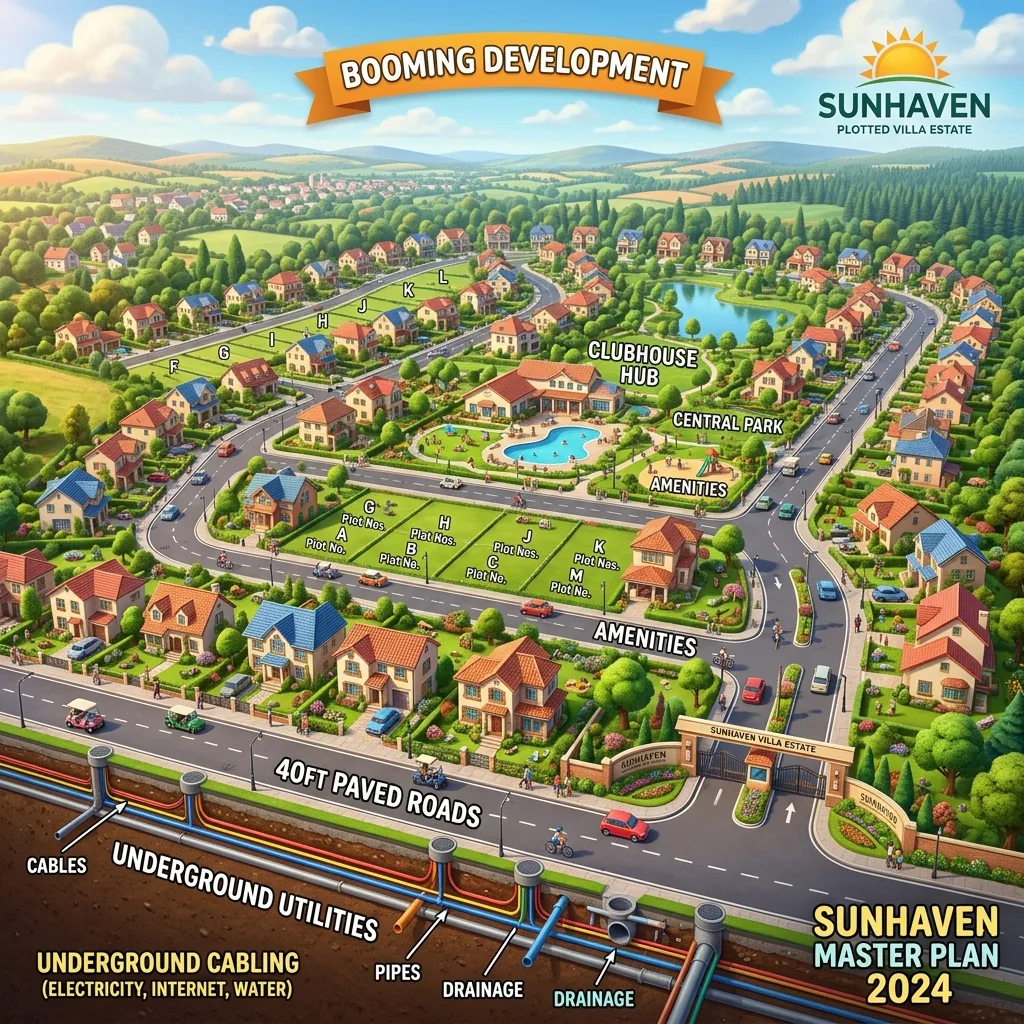
In the current format the developer lays internal roads to specification before handover, runs utilities underground, walls and gates the perimeter, landscapes the common areas, and secures statutory approval before registering the first plot.
Sanctuary at Julkal is a working example: an HMDA-approved gated community of 475 plots across 45 acres, sizes from 200 to 750 square yards, handed over ready to construct rather than ready to imagine.
The difference is what the buyer actually acquires. In the old model you bought a coordinate on a drawing. In this one you buy a finished piece of civic infrastructure with a title attached.
The capital cycle is what brought serious developers in
Set aside the marketing and look at the structure of the money.
A plotted project moves from land assembly to handover in a fraction of a high-rise's timeline. No multi-year construction phase, no crane, no slab cycle. Approval to delivery is measured in quarters rather than half-decades. Capital invested in land and infrastructure returns quickly and recycles into the next project instead of sitting inside an unfinished structure.
Risk falls at the same time. The biggest failure modes in residential development — construction cost escalation, contractor default, unsold inventory in a completed tower — either shrink dramatically or disappear. The developer's obligations reduce to civil works, utilities and paperwork. Demanding, but bounded.
When faster capital cycles and lower execution risk arrive together, reputation-conscious players enter, and competition shifts from price to product. That is exactly what has happened in West Hyderabad. Developers now compete on internal road widths, avenue plantation and the ambition of the clubhouse — dimensions the old venture promoter never considered. Raghunath County, DTCP-approved across 19 acres fronting the Shankarpally–Mehtabkhan Guda–Mominpet main road, carries the new grammar: 40-foot and 33-foot cement-concrete roads, an entrance arch, streetlights, underground utilities, landscaped open spaces.
Buyers changed too, in three specific ways
Supply-side economics alone would have produced more of the old chaos. Something also shifted in what households want.
Space and control. Long stretches of working from home recalibrated how families think about dwellings. A compact flat optimised for office proximity makes less sense when the office is partly optional. What gained value was room — a study, a garden, space for parents to stay — and, more subtly, authority over one's own environment. A plot delivers both: the eventual footprint of an independent house, with layout, orientation, floors and finishes decided by the owner rather than a brochure.
Fatigue with construction risk. Years of stalled apartment projects across Indian metros taught buyers what it means to pay today for a structure promised later. An under-construction flat bundles your capital with a developer's funding discipline, contractor performance and approval renewals. A developed plot decouples most of that. Once the layout is sanctioned, the infrastructure laid and the deed registered, there is no tower left to finish.
Sequencing. A plot lets a family stage its largest financial decision. Buy the land now, in a corridor you have researched. Build in three years, or seven, when careers, schools and savings align. Nothing in the apartment format permits that. It also suits non-resident buyers, who can complete a FEMA-compliant purchase remotely while construction waits for an eventual return.
Regulation built the floor this stands on
Between the buyer's new appetite and the developer's new economics sits an underappreciated third force.
Telangana's approval architecture — HMDA inside the metropolitan area, DTCP beyond it, with TS-bPASS streamlining the process — created a checkable line between an approved layout and everything else. An approved layout has sanctioned road widths, mandated open-space reservations and utilities planned to standard. An unapproved one has a drawing.
RERA extended that discipline to conduct. Registered plotted projects carry disclosure obligations, advertised specifications become commitments, and buyers gain a forum with some teeth.
None of this removes the need for diligence. It makes diligence possible, because there is now a public record to check against. The practical result is a sorted market: organised approved communities and grey-market ventures occupy visibly different categories, priced differently, financed differently. Banks lend readily against approved plots and reluctantly against unapproved ones, which quietly channels serious buyers towards one side of the line.
The clubhouse solved the format's oldest weakness
Approvals gave the category legitimacy. The clubhouse gave it desirability, and it did so by attacking a genuine flaw.
In a conventional layout, community life begins only when enough houses are built and occupied, which can take a decade. Until then an owner holds an address they cannot use. A clubhouse inverts the sequence: the shared realm is delivered complete on day one, so owners who have not built can still swim, play, entertain and host inside their own community.
Sanctuary's 25,000 sq. ft. clubhouse is built on that logic — banquet hall, restaurant and café, swimming pool complex, two indoor badminton courts, gym, indoor games lounge, a business centre with co-working space, and three guest suites.
The guest suites and the co-working space deserve attention. They let an owner stay overnight on visits, supervise construction without commuting from the city, or work a full day at the community years before their own house exists.
The cost nobody puts in the brochure
Here is the honest weakness of the format, and it does not disappear because the clubhouse is good.
A plotted community fills in slowly, house by house, on the timetable of several hundred separate households. That means years of living beside construction: cement dust, labour vehicles, a half-built neighbour, streets where one house in five is occupied. An apartment complex is finished on handover day. A plotted community is finished when its last owner decides to build, and nobody can tell you when that will be.
There is a second, quieter risk. A gated layout's long-term quality depends on maintenance governance — how the corpus is collected, who administers it, and what happens when the developer hands over to a residents' association. Ask about that structure explicitly, in writing, before you buy. It determines whether the streetlights are still working in year twelve.
Neither point argues against the format. Both argue for buying with your eyes open and for weighting the developer's track record more heavily than the amenity list.
Optionality is the actual product
Strip away the landscaping and what a modern plotted community sells is choice.
The owner decides when to build — now, later, or in stages as budget allows. The owner picks the architect, contractor, materials and design language. A courtyard house and a contemporary flat-roofed box can stand on adjacent plots, and the street is better for the variety.
For many Hyderabad families Vaastu compliance is not negotiable, and plots hold a decisive advantage over apartments, where orientation is whatever the floor plate dictates. A carefully planned layout can deliver compliant parcels across the grid — Sanctuary's plots are laid out to Vaastu principles by design — after which the owner controls every subsequent decision.
Plot sizing extends the same logic. A range from 200 to 750 square yards inside one community lets a young couple's first landholding and a joint family's future homestead sit behind the same gate, each buying exactly the land they need.
Judge a developer by what has already been handed over
Every layout under sale looks broadly similar in a brochure. The difference between operators shows in the projects they finished years ago, and those are open to anyone willing to drive to them.
Ask which layouts the developer has completed, then go and look at the oldest one. Are the streetlights working? Is the avenue plantation alive, or was it planted for photographs and abandoned? Does the compound wall still stand along its whole length? Is the clubhouse open and staffed, or locked?
Ask whether the plots mortgaged to the authority in those earlier projects have been released. A release means the promised internal works were completed to the authority's satisfaction, which is a considerably harder test than a marketing claim.
Ask whether maintenance has been handed to a residents' association, and if so, when and how the corpus transferred. A developer who has done this cleanly once will describe the mechanics readily. A developer who has never done it will describe intentions.
Then talk to owners in that older project without the sales team present. Ten minutes at the gate of a completed layout is worth more than a day of presentations about the one being sold.
Three things to check, in the original
The approvals. Ask for the HMDA or DTCP sanction with its layout permit number, and the RERA registration where applicable. Verify both against the regulator's own records rather than the brochure. Confirm that your specific plot sits inside the approved layout and matches the sanctioned plan's numbering and dimensions.
The title. Commission an independent legal opinion tracing ownership through the link documents, and obtain an encumbrance certificate covering a long period. Confirm the land is converted to non-agricultural residential use and that no notification — acquisition, master-plan road alignment, buffer zone — touches the parcel. A lender's willingness to finance is corroborating evidence, never a substitute.
The ground. Walk the layout. Approved drawings show what is sanctioned; your eyes confirm what exists. Are internal roads laid in concrete to full width or merely formed? Are water, power and drainage physically installed underground, or "provisioned"? Is the compound wall complete, the entrance built, the streetlighting live? A site visit settles in an hour what no brochure can, and a developer confident in the ground will encourage the inspection rather than choreograph it.
Where the category goes next
Every durable shift in real estate happens when demand, supply and regulation move together, and this one is a clean example. Buyers wanted space, control and completed assets. Developers found a model that rewards speed and punishes over-promising. Regulators built a framework that separates the honest operator from the opportunist by public record.
Hyderabad's western corridor is where the maturing is easiest to observe. Our own pipeline reflects it: alongside Sanctuary and Raghunath County in Shankarpally, an upcoming project at Mansanpally extends the same approach to the southern airport corridor. Details will be announced when they are settled, and we will not describe them before then.
The Sunday-morning venture with hand-painted flags is not coming back. What replaced it promises only what is already built and leaves the most personal decision — the house — where it belongs.
Before you compare amenities anywhere, ask two questions: what does the maintenance handover structure look like, and how many plots in this layout are already built on. The answers will tell you more about the next ten years than any render. Then arrange a visit and check the roads yourself.
Verification of title, approvals and on-ground development is the buyer's responsibility. Land values are subject to market conditions.